
Product / System 1000
We delivers protection with precision, regional reach
and technical excellence.
nVent ERICO System 1000 is a globally trusted Early Streamer Emission (ESE) lightning protection solution engineered to comply with NFC 17-102:2011 and similar international standards. Built on robust engineering principles and proven field performance, System 1000 integrates advanced ESE air terminals, optimized mast systems, high-efficiency downconductors, and reliable grounding methods to provide complete lightning protection for modern structures.
System 1000 follows nVent’s internationally recognized Six Point Plan of Protection, ensuring a holistic approach to lightning safety—capturing, conducting, and safely dissipating lightning energy.
1. Advanced ESE Air Terminals (Interceptor i-Series)
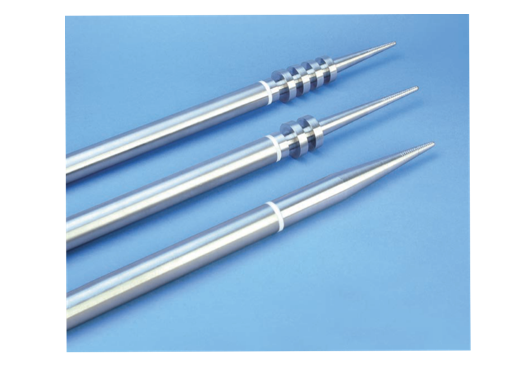
The heart of System 1000 is the Interceptor i-Series ESE terminals, designed to generate an early upward streamer, enabling faster strike capture than conventional passive lightning rods.
Available Models
- SI25i – 25 μs triggering time
- SI40i – 40 μs triggering time
- SI60i – 60 μs triggering time
Key Features
- Fully compliant with NFC 17-102:2011
- Tested in accredited high-voltage laboratories
- Manufactured using 304/316 stainless steel
- Compatible with tape, cable, smooth-weave, isolated down conductors (ISOnV), and ERICO Ericore
- Backed by test reports, installation manuals, and engineering design support
2. ✔ UL Certified (Global Listing)
The nVent ERICO Interceptor i-Series ESE air terminals are UL Listed globally under:
UL Listing Number: E507847
Category: OVHC
Standard: NF C 17-102:2011
This UL listing provides third-party verification that the Interceptor i-Series air terminals comply with the ESE performance requirements defined in NFC 17-102 and meet UL’s stringent safety and performance criteria.
3. ESE Protection Radius (Rp) According to NFC 17-102:2011
The protection radius depends on:
- Terminal height (h) above the highest protected point
- Triggering advance (ΔT = 25 / 40 / 60 μs)
- Required protection level (I, II, III, or IV)
- Standard geometric factor (r = 20, 30, 45, 60 m)
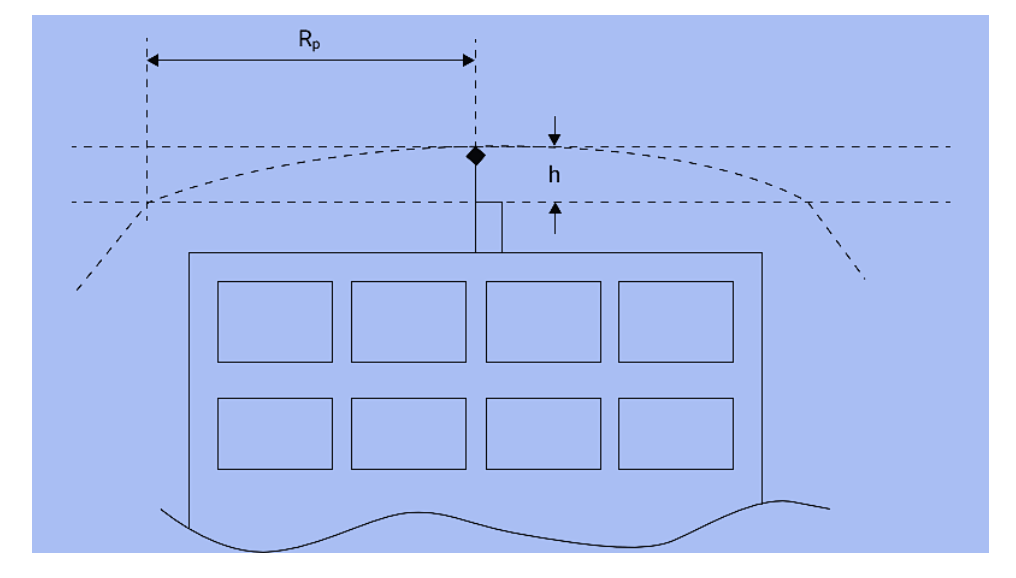
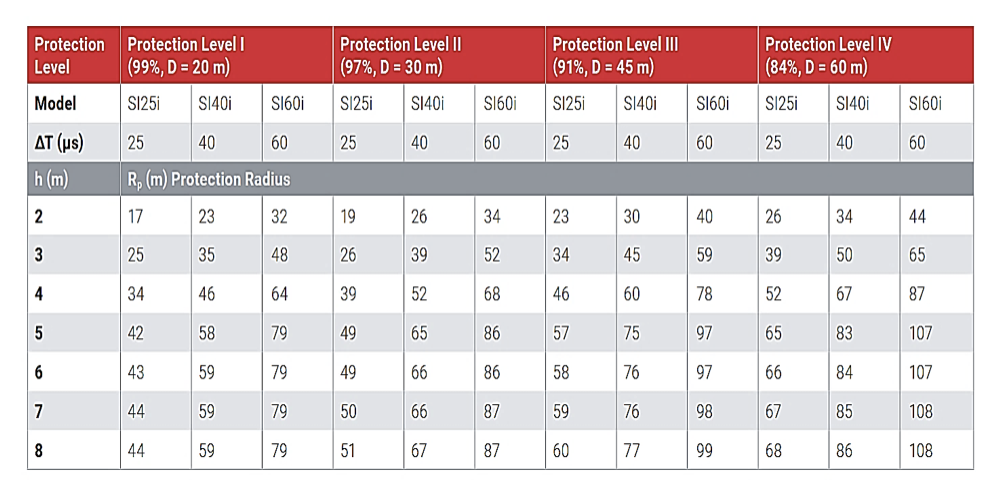
According to NFC 17-102:2011, the standard protection radius (Rp) of the ESE i-Series is linked to ΔT (below), the protection levels I, II, III or IV (as calculated in EN 62305-2) and the height (h) of the ESE i-Series above the structure or feature to be protected (defined by NFC 17-102 as a minimum 2 m)
For h ≥ 5m
For 2m ≤ h ≤ 5m
h – Height (m) of the mast above the surface to be protected
s
r – Depends on the selected level of protection (in meter)
r = 20 for Level 1 protection ; r = 30 for Level 2 protection
r = 45 for Level 3 protection ; r = 60 for Level 4 protection
The radius of protection of different ESE air terminals for different heights at different levels is as follows.
4. Engineering & Design Support
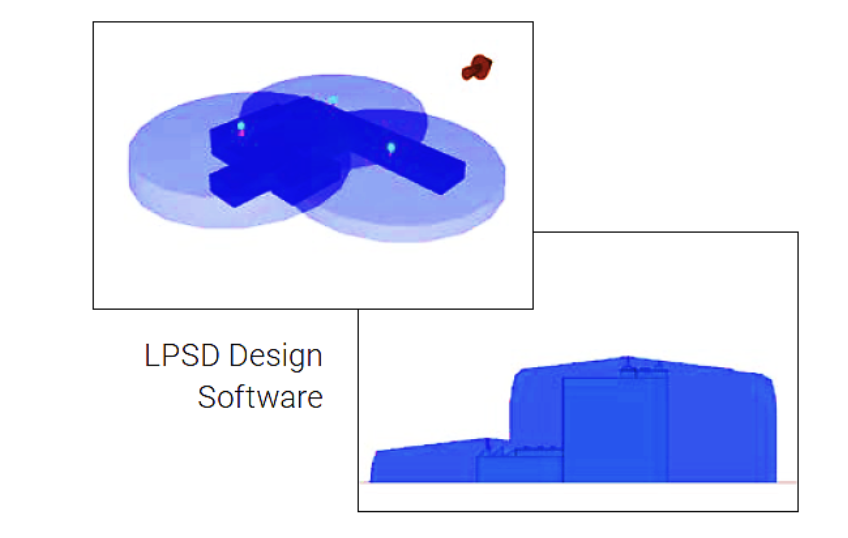
nVent provides comprehensive engineering support through its Lightning Protection System Design (LPSD) platform, ensuring that every System 1000 installation fully complies with the requirements of NFC 17-102:2011, the governing international standard for Early Streamer Emission (ESE) lightning protection systems.
LPSD Output Includes
- Detailed 2D and 3D design layouts
- Determination of protection parameters as defined in NFC 17-102:2011
- Optimized ESE terminal placement based on required protection radius (Rp)
- Accurate downconductor routing as per NFC 17-102 installation guidelines.
- Grounding system recommendations suited for ESE installations.
By incorporating site dimensions, mast heights, risk category, and the ΔT value of the selected ESE terminal, the LPSD tool generates a complete and compliant ESE lightning protection design that aligns strictly with NFC 17-102:2011.
By incorporating site dimensions, mast heights, risk category, and the ΔT value of the selected ESE terminal, the LPSD tool generates a complete and compliant ESE lightning protection design that aligns strictly with NFC 17-102:2011.
5. Downconductors & Routing Requirements
In accordance with NFC 17-102:
- Minimum cross-section: ≥ 50 mm²
- Minimum paths: 2 downconductors for each non-isolated ESE terminal
- Bonding: All metallic objects within the strike zone must be equipotentially bonded
- Compatibility: Supports Ericore and ISOnV isolated downconductors for sensitive applications such as data centers, explosive zones, hospitals, and telecom towers
Proper routing minimizes impedance and ensures controlled dissipation of lightning energy.
6. Grounding & Earth Termination
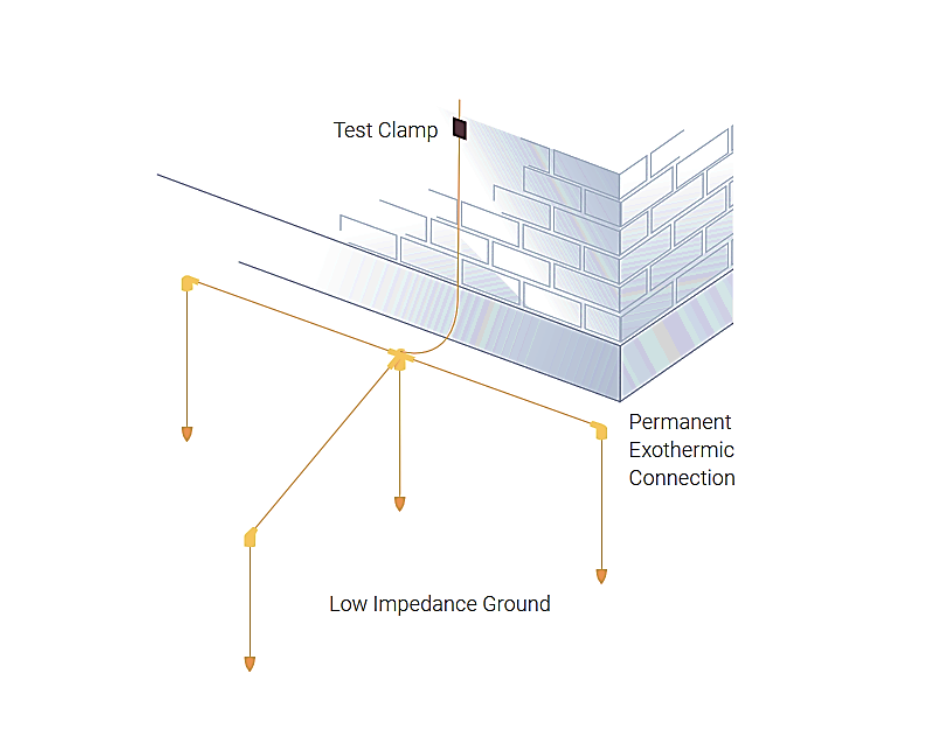
The transient nature of lightning with its associated fast rise times and large magnitude currents mean that special consideration needs to be given to grounding for lightning protection to be effective. A poorly grounded system increases the likelihood of the strike flashing over to the structure and/or finding a non-preferred path within the structure. Many factors, such as soil resistivity variations, installation accessibility, layout and existing physical features are all site-specific and tend to affect decisions on grounding methods employed. The primary requirements of a direct strike grounding system are to:
- Efficiently dissipate lightning energy into the ground
- Help protect equipment and personnel
- Provide good corrosion resistance/long life.
The ground electrode system should be corrosion resistant and bonded to the structural ground system. Copper and copper-bonded steel are the most common materials used for grounding conductors. nVent also recommends the use of nVent ERICO Ground Enhancement Material (GEM) to ensure an optimal ground. GEM is a low-resistance, non-corrosive, carbon dust-based material that helps improve grounding effectiveness, especially in areas of poor conductivity.
System 1000 delivers a fully engineered, standards-compliant, and globally certified ESE lightning protection solution that ensures maximum structural safety, long-term performance, and reliable protection across all types of facilities.