
Product / Earthing solutions
We delivers protection with precision, regional reach
and technical excellence.
Earthing & Bonding Solutions
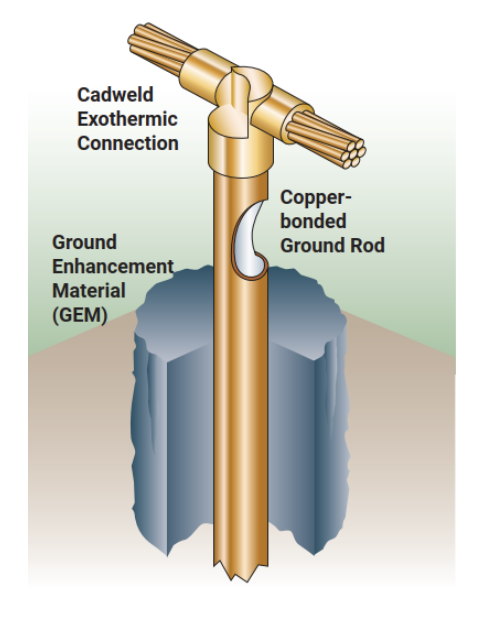
nVent ERICO offers a complete portfolio of earthing (grounding) and bonding products engineered to protect people and equipment by safely dissipating fault currents and lightning energy into the earth. Our solutions – including high-quality copper-bonded steel ground rods, conductive ground enhancement material (GEM), Cadweld exothermic weld connectors, and a full range of clamps and connectors are designed for ultra-low impedance grounding networks that meet or exceed industry standards (UL 467, IEEE Std 80, IEC 62561, etc.). Engineered for long-term reliability and minimal maintenance, these products form the backbone of certified grounding systems in industrial, utility, telecommunications, and commercial applications.
Copper Bonded Steel Rod (Earth Electrode)
The earth electrode is the primary component of an effective earthing system. nVent ERICO’s Copper Bonded Steel Rods consist of a high tensile low-carbon steel core molecularly bonded with 99.9% pure electrolytic copper (250 microns average thickness), manufactured in accordance with UL 467 and IEC 62561-2.
Key Features:
- 99.9% pure electrolytic copper coating
- Molecular bond nickel-sealed high strength steel core
- Minimum copper coating of 10 mils (250 microns)
- UL Listed and ISO-certified process
- Greater than 90,000 PSI tensile strength
- Corrosion resistance, high fault current capacity (IEEE Std 80)
- Compliant with ANSI/NEMA, IEC 62305-3 Ed.2, ASTM 370, ASTM 376
- CPRI tested for short-time current
- Rod length: 10 ft (minimum 8 ft for UL compliance)
- Compression couplers for extended depth applications
The average life expentency of different types of earth electrodes are as follows.
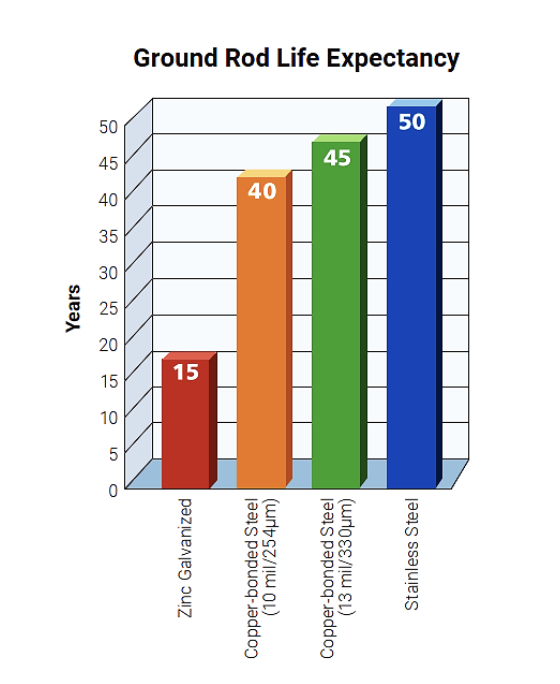
Note: The lifespan of an earth electrode can be significantly reduced in low-resistivity soils due to their higher corrosivity.
The rate of corrosion on two different types of earth electrodes that were installed on the soil is as follows.
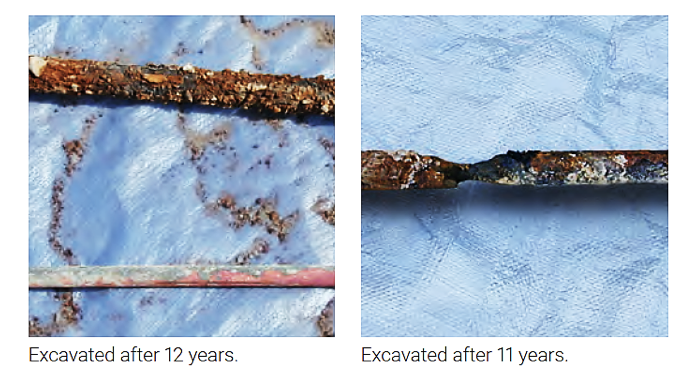
The photo on the right shows a galvanized steel ground rod driven vertically into the ground at the Pawnee testing site in Las Vegas, NV. One area is reduced from a 3/4″ diameter to approximately a 1/4″ diameter due to extensive corrosion. The eventual failure would result in a potentially catastrophic loss of ground.
Ground Enhancement Material (GEM)
GEM is a carbon-based, non-corrosive, low-resistance material that enhances grounding system performance, especially in poor soil conditions. Once set, GEM does not shrink or expand and maintains consistent contact with the electrode.
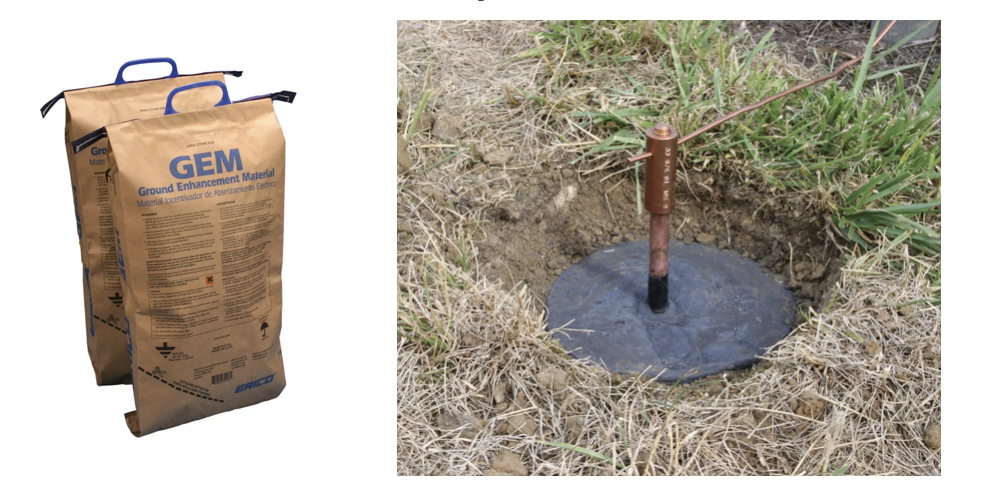
Key Features:
- Electrically conductive (metal-like)
- Corrosion-free in contact with copper
- No shrinkage, swelling, or decomposition
- Low resistivity: <0.02 ohm-m (ASTM G187-12)
- Solidifies like concrete when mixed with water
- Complies with IEC 62561-7 and IEEE Std 80
- Tested for environmental and corrosion resistance
- Thermally stable (-60ºC to +60ºC)
- Meets EPA landfill requirements
Copper Bonded Steel Conductor (CBSC)
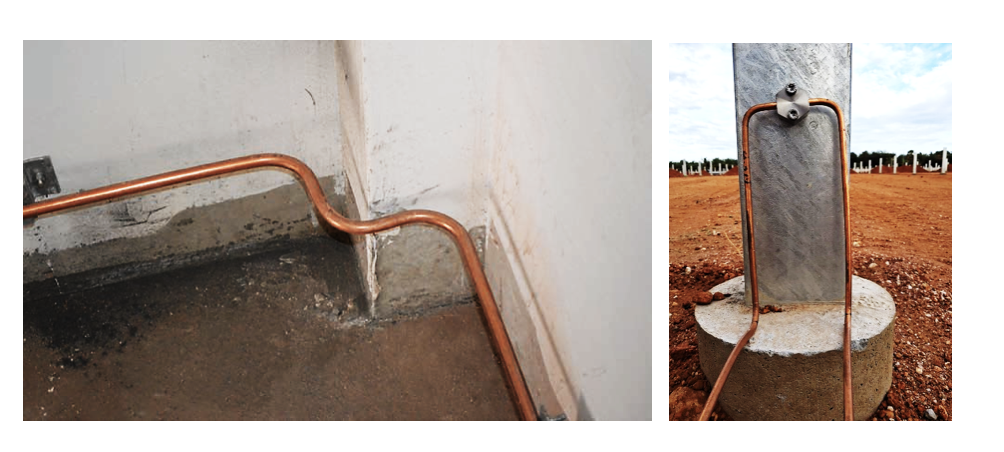
The nVent ERICO Cu-Bond Round Conductor is comprised of an electro-plated coating of copper deposited over a layer of nickel surrounding a steel core. This process helps ensure a long-lasting molecular bond between the copper layer and the steel. The conductor core consists of a low-carbon steel grade for improved flexibility in the field. The copper surface of the conductor provides high conductivity and corrosion resistance properties.
CBSC cables from ERICO are round conductors used to interconnect ground rods and provide a uniform potential across the grounding network. They consist of a nickel-sealed copper layer electroplated onto a steel core.
Key Features:
- 99.9% pure electrolytic copper coating
- UL Certified to IEC® 62561-2, Requirements for Conductors and Earth Electrodes.
- Meets the requirements of IEC® 62305-3, Edition 2, for Lightning Protection.
- Materials manufactured according to ASTM 370 to confirm steel quality and ASTM 376 to verify copper thickness.
- Meets the requirements of IEC 62305-3, Edition 2, for Lightning Protection.
Ground Resistance Design & Simulation (with GEM Calculator)
- Each grounding system is engineered based on a combination of parameters, including:
- Fault current levels and discharge duration
- Soil resistivity profiling with layered analysis
- Conductor sizing in accordance with thermal and mechanical requirements
- Equipment characteristics to determine grounding response
- Interconnection and bonding to ensure equipotential surfaces
- Designs are customized using simulation tools like the GEM Calculator, in compliance with key international and national standards such as IEEE Std 80, IEEE Std 837, IEC 62561-2, IEC 62305-3, UL 467, IS 3043, IS 732, and BS 7430.
Note: Grounding design must be tailored to each site’s electrical, environmental, and structural variables for reliable system performance.
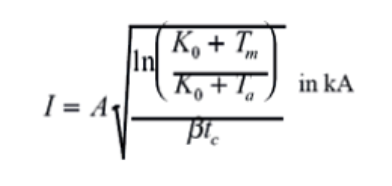
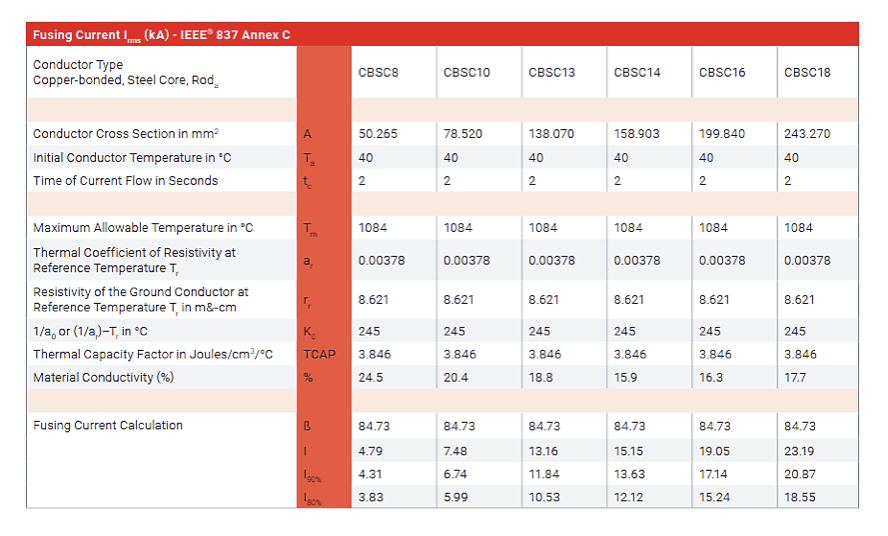
The IEEE 837 standard (Annex C) provides a method of calculating the fusing current for conductors. The following chart is a reference of the calculations for copper-bonded steel conductor according to the IEEE 837 standard.
Equipotential Bonding in Industrial Facilities
Equipotential bonding is a critical element in any industrial grounding strategy. By interconnecting all earthing points across the facility — including equipment grounds, structural steel, and surge protection interfaces — a uniform earth potential is maintained throughout the premises.
This significantly reduces potential differences between equipment during fault or lightning events, minimizing risks of electric shock, equipment failure, or electromagnetic interference.
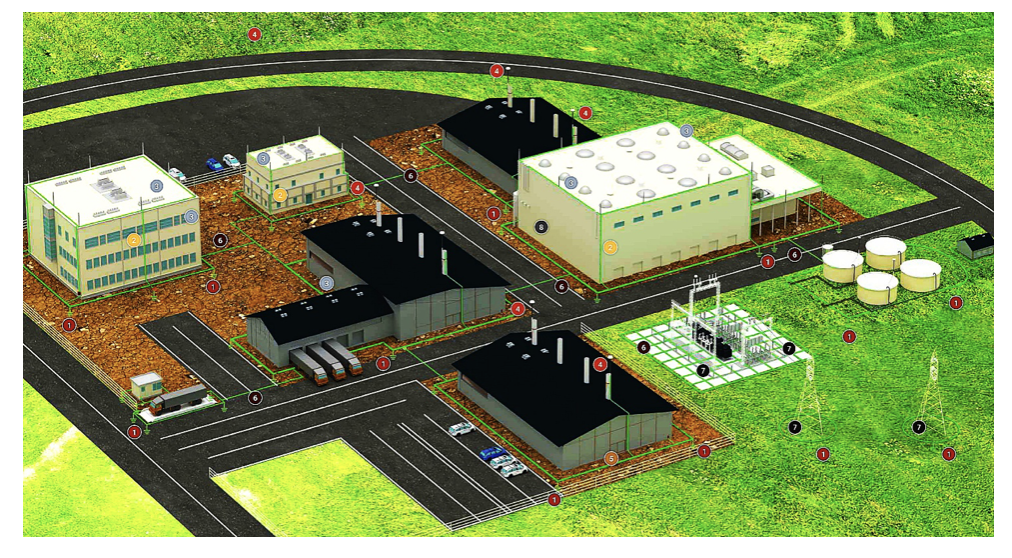
Benefits of Equipotential Bonding:
- Prevents hazardous voltage gradients between structural elements, equipment, and conductive surfaces
- Improves safety for personnel and assets in environments with high fault or lightning exposure
- Enhances surge protection performance by maintaining a unified reference potential for transient current dissipation
- Minimizes electromagnetic interference (EMI) by preventing circulating ground currents, eliminating voltage differentials across equipment, and stabilizing signal reference levels for sensitive electronic systems
- Ensures consistent bonding of all metallic infrastructure — including cable trays, equipment housings, and structural steel — using ERICO’s copper-bonded conductors and permanent connections
Note: Design must be customized to each industrial layout considering soil resistivity, electrical loading, and critical equipment zones.